Building Knowledge
Navigating humidity in gypsum product installation
Guidance for installing and finishing gypsum products when jobsite humidity can affect performance
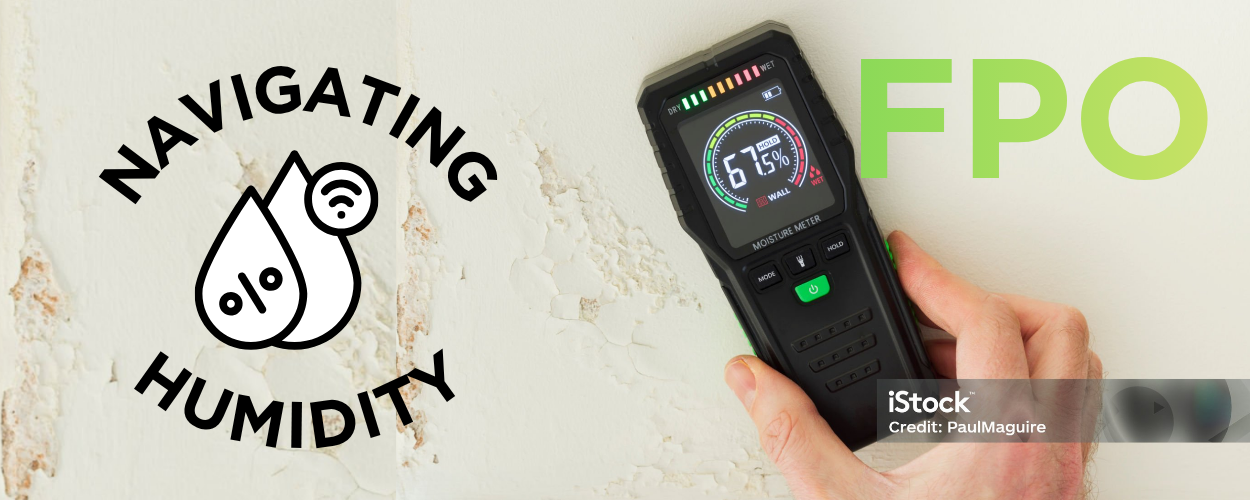
When it comes to people and building materials on a work site, humidity is a big deal. We all know to say hydrated, but what does humidity mean for gypsum products? Whether it’s hanging or finishing board, environmental controls must be maintained to avoid joint cracking, tape failure, ceiling sagging, delayed shrinkage and costly mold remediation callbacks.
This article covers commonly asked questions surrounding the installation and performance of gypsum board, glass-mat panels and joint finishing compounds under humid conditions, including a high-level summary of the science behind humidity.

It helps to understand the science behind humidity in order to make sense of its effects on gypsum products. Humidity describes the amount of water vapor present in the air. The laws of physics and thermodynamics govern its movement and behavior in indoor spaces and in global climate systems.
Moisture moves from warm to cold
- Vapor pressure differences: Warm air contains more thermal energy, allowing water molecules to evaporate rapidly and create a high vapor pressure. Cold air has lower thermal energy and lower vapor pressure.
- Thermal migration: Because systems naturally move toward equilibrium, water vapor migrates toward colder spaces. When warm, humid air contacts a cool surface, it loses thermal energy and drops below its dew point, resulting in condensation.
Moisture moves from high to low concentration
- Vapor diffusion: Water vapor naturally diffuses down a concentration gradient — from areas of high moisture content to areas of low moisture content — until equilibrium is reached.
- Structural impact: This gradient drives moisture through porous building materials, such as drywall, insulation and wood, from damp exteriors to drier interiors, or vice versa, depending on the season.
Air moves from high pressure to low pressure
- Pressure gradient force: Air behaves as a fluid. When a high-pressure air mass (dense air) sits near a low-pressure air mass (less dense air), air accelerates toward the lower pressure to equalize the force.
- Bulk transport (advection): As air flows along this pressure gradient, it transports all suspended water vapor with it. This mass movement of air creates thermal gradients across a wall cavity.
Gravity acts downward
- Buoyancy mechanics: Counterintuitively, humid air is less dense than dry air . Consequently, warm, moist air rises.
- Precipitation and drainage: As warm humid air ascends into cooler, lower-pressure areas, the water vapor condenses. Once the condensed liquid droplets become too heavy for upward air movement to support, gravity pulls them down as liquid water. This necessitates the need to drain the moisture from the wall cavity.

Temperature and climate control requirements
Gypsum panel installation and finishing require environmental management before, during and after application.
- Attic Ventilation and Vapor Control: Proper ventilation or conditioned attic spaces must be provided to remove moisture buildup above gypsum board ceilings. A vapor retarder may be required behind the gypsum board in exterior ceiling assemblies.
- Finishing & Adhesive Application Minimum: Room temperature must be maintained at a minimum of 50-degrees Fahrenheit continuously for adhesive attachment, joint treatment, texturing and decoration. This temperature must be established at least 48 hours prior to application and maintained continuously until all materials are thoroughly dry.
- Board Application Minimum: Room temperature must be maintained at a minimum of 40-degrees Fahrenheit during gypsum board installation.
Acceptable jobsite humidity levels
Contractors frequently ask: “What is the exact numerical relative humidity percentage cutoff for installing drywall?”
There is no single maximum relative humidity percentage cutoff for hanging gypsum boards. It’s a different story for drywall finishing. When mudding walls, keep the ambient temperature, humidity and airflow as constant and as close to occupancy environmental conditions as possible. Adequate, continuous ventilation must be actively maintained 24 hours a day throughout the application, curing and drying cycles.
Physical effects of humidity on gypsum board
Understanding how atmospheric moisture interacts with gypsum cores and facers helps prevent structural and aesthetic defects:
- Dimensional Stability: Gypsum boards are dimensionally stable under standard atmospheric shifts, exhibiting negligible expansion or contraction.
- Ceiling Sagging Risks: High humidity combined with heavy, water-based spray textures can cause unprimed ½" gypsum board installed on ceilings to sag if framing spacing exceeds recommendations (16" o.c. max for standard ½") or if space drying conditions are unventilated.
- Wicking Mitigation: To prevent wicking of moisture from concrete slabs or masonry walls, installers must leave a minimum ¼" gap between panel edges and concrete floors, masonry or adjoining concrete structures.
- Mold Vulnerability: Standard paper-faced gypsum board contains cellulose — an organic food source for mold. When paper facers remain damp in elevated humidity (more than 70% relative humidity) without airflow, mold spores can proliferate. Gold Bond® XP® family of gypsum board products and Gold Bond® eXP® family of gypsum panel products avoid this problem with a moisture-, mold- and mildew-resistant face and back paper and a moisture-, mold- and mildew-resistant core.

Relative humidity governs the evaporation rate of ready-mix joint compounds. As relative humidity rises, drying times increase significantly. Reference the ProForm® Finishing Products drying time chart below for guidance on how temperature and relative humidity affect ready-mix joint compound drying times.
ProForm Products Drying Time vs. Relative Humidity Reference Chart
| Relative Humidity | 50°F | 60°F | 70°F | 80°F | 100°F |
|---|---|---|---|---|---|
| 0% | 19 Hours | 13 Hours | 9 Hours | 6 Hours | 3 Hours |
| 20% | 23 Hours | 16 Hours | 11 Hours | 8 Hours | 4 Hours |
| 40% | 29 Hours | 20 Hours | 14 Hours | 10 Hours | 5 Hours |
| 50% | 36 Hours | 24 Hours | 17 Hours | 12 Hours | 6 Hours |
| 60% | 42 Hours | 29 Hours | 20 Hours | 13.5 Hours | 8 Hours |
| 70% | 2.25 Days | 38 Hours | 26 Hours | 19.5 Hours | 10 Hours |
| 80% | 3.25 Days | 2.25 Days | 38 Hours | 27 Hours | 14 Hours |
| 98% | 26 Days | 18 Days | 12 Days | 9 Days | 5 Days |
Can ProForm products be used in high-humidity environments?
Yes, ProForm products are formulated for high-performance finishing across a spectrum of jobsite environments, and the full product family includes mold and mildew resistance.
- Mold Resistance Scores: ProForm® All Purpose with Dust-Tech® Joint Compound and ProForm® Lite Blue® with Dust-Tech® Joint Compound achieve perfect mold scores: 10 on ASTM D3273 and 0 on ASTM G21.
- Strategic Selection for High Humidity: When relative humidity exceeds 70% to 80%, ready-mix evaporation slows dramatically (taking up to days per coat). Under high humidity or fast-track schedules, contractors should switch to setting compounds, which harden through a chemical reaction rather than evaporation, delivering predictable recoat times regardless of ambient humidity.
Dos and don’ts of drywall finishing in high humid conditions
DO:
- DO establish active mechanical air movement across joint surfaces to encourage moisture dissipation.
- DO maintain room temperatures at 50-degrees Fahrenheit or higher 24 hours a day throughout application and drying.
- DO use setting-type compounds for fast hard-set requirements under humid or pre-rock conditions.
- DO verify that each coat of compound is completely dry and hardened before applying subsequent coats or primer/paint.
- DO use dehumidifiers as needed to maintain ideal drying conditions, targeting a room relative humidity of approximately 30% to 50%. Controlling humidity within this range promotes more consistent joint compound drying, reduces drying time and helps minimize finishing defects.
DON’T:
- DON’T apply joint compound over damp, cold or wet surfaces.
- DON’T finish joints on paper-faced panel assemblies until the building envelope is weather-tight and dried-in.
- DON’T prime or paint over joint compound that retains internal moisture; doing so traps water, resulting in delayed joint shrinkage, joint photographing and white band show-through.
- DON’T use unvented gas space heaters to force-dry joints. Burning fossil fuels generates vast quantities of water vapor that condense on walls and dramatically worsen humidity.
Hanging gypsum boards before the building is weather-tight
Typical building code prohibits paper-faced drywall from being installed before the building is fully enclosed. Paper-faced products such as Gold Bond® XP® Gypsum Board must be protected from direct weather exposure. Likewise, these products should not be installed in areas subject to continuous or excessive moisture and extreme humidity, for example showers, saunas, steam rooms or indoor pool enclosures.
If interior framing panels must be installed before complete envelope enclosure, specifiers and contractors can use Gold Bond® eXP® Interior Extreme® Gypsum Panels, which have coated fiberglass facers instead of paper facers. They are engineered and warrantied for pre-rock before the building is enclosed and are backed by a 12-month extended weather exposure warranty.
Technical support
For guidance on gypsum board installation, finishing or product selection in high-humidity conditions, contact 1-800-NATIONAL® Construction Services.
Connect Now