Fire Resistance
A guide to recessed items in fire-rated walls
Understanding how 5-sided boxes can help protect recessed items in fire-rated wall assemblies
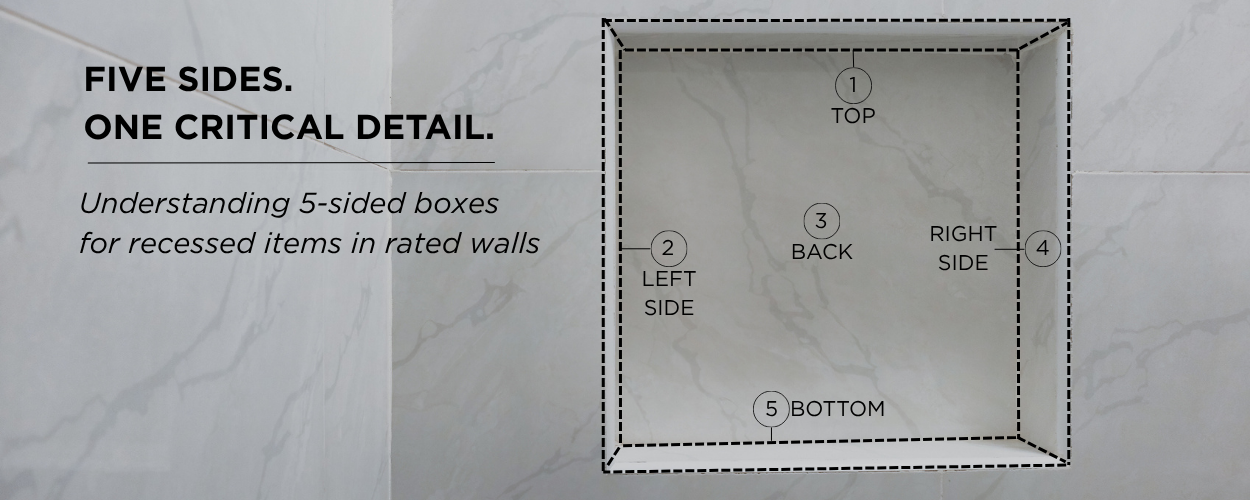
A 5-sided box is a gypsum board enclosure used to help protect recessed items, such as cabinets, niches or utility boxes, installed within a fire-rated wall or rated wall assembly, but approval depends on the project design professional and the local Authority Having Jurisdiction (AHJ). When a project calls for an inset feature, contractors and designers can face a challenge: how do you maintain the intended performance of the wall assembly while accommodating the recessed element?
To help explain this field condition, Krista Karlson, Construction Services Manager with the 1-800 NATIONAL® Construction Services team, provides practical guidance on what project teams should know.
While not a tested fire-rated assembly on its own, a 5-sided box is often used as a field-applied solution to help protect recessed elements installed within rated wall systems. Understanding what a 5-sided box is, when it may be appropriate, how it is constructed and where approval limitations exist can help project teams avoid costly surprises during construction.
What Is a 5-Sided Box?
A 5-sided box is a gypsum board enclosure constructed around a recessed opening in a fire-rated wall. As the name suggests, the enclosure consists of five sides, leaving one side open to accommodate the recessed item or opening. The gypsum board surrounds the top, bottom, back and sides of the opening, creating a continuous layer of protection around the recessed feature.
Think of a shower niche, medicine cabinet, washer box or recessed utility connection installed within a wall cavity. Instead of leaving an unprotected opening in the wall assembly, the recessed area is wrapped with gypsum board, creating a protective enclosure.
From a construction standpoint, 5-sided boxes are often assembled using gypsum board, gypsum screws and setting compound, such as ProForm® Quick Set Lite™ Setting Compound, without the benefit of traditional framing throughout the enclosure. For consistency with the rated wall assembly, the gypsum board used to construct the box should ideally match the board used in the rest of the wall.
Why Are 5-Sided Boxes Used?
The primary purpose of a 5-sided box is to address a condition where something has been recessed into a fire-rated wall and could compromise the intended performance of the assembly. This is particularly important where an unprotected opening may create a pathway for fire, smoke or heat to move through the wall cavity.
In many cases, project teams discover late in the process that a selected component does not have a rated enclosure. Rather than replacing the item, they may investigate whether a 5-sided box can be used as a solution. A 5-sided box is often a solution to a condition where a rated enclosure doesn't exist or is not provided.
Common Applications
Common examples of recessed items in rated walls can vary across commercial and residential projects and may include:
- Recessed medicine cabinets
- Washer and dryer connection boxes
- Ice maker water connections
- Specialty light fixtures installed in rated floor-ceiling assemblies
- Shower niches and other recessed architectural features
These situations generally involve something that has been set into a rated wall or assembly without a separately rated enclosure
Are 5-Sided Boxes Accepted Everywhere?
One of the most important considerations is that acceptance of a 5-sided box ultimately rests with the local Authority Having Jurisdiction (AHJ). The AHJ has the final authority to determine whether a proposed solution is acceptable for a specific project. Different jurisdictions may reach different conclusions, even on similar projects.
Are 5-Sided Boxes Tested Assemblies?
Another key point is 5-sided boxes are not typically included within UL fire-resistance designs and are not typically a separately tested fire-rated assembly. These applications are often a modification of a field condition rather than a tested detail.
In some situations, an engineering judgment may be required if project stakeholders need additional documentation to support the proposed approach.
Because there is no single tested design that applies universally, construction details and acceptance criteria can vary based on project requirements and local jurisdictional preferences.
Design and Construction Considerations
When evaluating a 5-sided box for a recessed cabinet, niche, utility box or similar condition, several design and construction factors should be reviewed:
- Match the Wall's Rating Requirements. The enclosure should be constructed using materials appropriate for the wall assembly's fire-resistance requirements. Consider the rating of the wall itself when determining appropriate gypsum board products and thicknesses. Often, 5/8" Type X gypsum board may be used.
- Location Matters. While a 5-sided box can technically be installed within a wall cavity, positioning it near framing members may provide additional support. Gypsum board itself is not structural, so installation details should account for stability and constructability. Additionally, 5-sided boxes are generally intended for one side of the wall, not opposing sides.
- Size Should Be Reasonable. The size of the recessed opening should be considered carefully. Larger openings may create greater risks regarding the performance of the wall assembly and may be more difficult to justify to an AHJ.
Frequently Asked Questions About 5-Sided Boxes
- Is a 5-sided box a fire-rated assembly?
No. A 5-sided box is typically not a separately tested fire-rated assembly. It is a field-applied gypsum board enclosure that may be reviewed as part of a project-specific solution.
- Who approves a 5-sided box in a rated wall?
Approval typically rests with the local Authority Having Jurisdiction (AHJ). Project teams should also coordinate with the design professional of record, who may consult with the project's fire protection engineer or other engineering professionals as needed to evaluate compliance with the applicable code, tested assembly requirements and project-specific conditions.
- What materials are used to build a 5-sided box?
A 5-sided box is commonly assembled with gypsum board, fasteners and setting compound. The board type, thickness and installation details should align with the wall assembly’s fire-resistance requirements.
- Can a 5-sided box be used for a recessed medicine cabinet or utility box?
A 5-sided box may be considered for recessed medicine cabinets, utility boxes, washer boxes, shower niches and similar inset features when no rated enclosure is available. Acceptance depends on project-specific conditions and AHJ review.
Key Takeaway
A 5-sided box can provide a practical solution when recessed components are installed within rated walls and no rated enclosure is available. However, it is not a one-size-fits-all answer.
Because 5-sided boxes are not standardized tested assemblies, acceptance depends on project-specific conditions and the requirements of the local Authority Having Jurisdiction. Before moving forward with this approach, coordinate with the project team, review applicable code requirements and consult the AHJ to determine whether the proposed solution is appropriate for your project.